
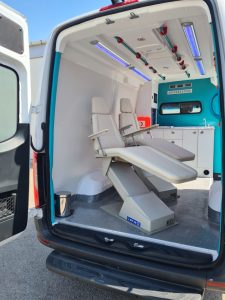
The landscape of dentistry is changing. Patients are no longer always willing to travel to a brick-and-mortar office, especially in rural areas or underserved communities. The solution? Bringing the clinic to them.
Whether you are searching for a mobile dental trailer, a dental sprinter, or wondering “what’s the best vehicle for a mobile dental clinic,” you have landed in the right place.
At Infinity Chassis Units (ICU Automotive) , we don’t just modify vehicles—we engineer complete, self-contained healthcare ecosystems on wheels. Our technical philosophy is simple: robust redundancy ensures uninterrupted operation.
In this guide, we will break down the types of mobile dental clinics available, the real costs involved, and the technical specifications that separate a reliable asset from a constant headache.
Part 1: Why Go Mobile? The Shift in Dental Care
The demand for mobile dental vehicles is exploding. Searches for “dentistry trailer” and “mobile dental clinics for sale” are at an all-time high. Why?
- Accessibility: You reach patients in nursing homes, schools, and remote areas.
- Lower Overhead: Compared to a physical office, the startup costs are significantly lower.
- Flexibility: You can move your practice where the demand is.
- Autonomy: You are not tied to a lease.
But to succeed, you need more than just a van with a chair inside. You need a mobile dental clinic vehicle that functions exactly like a fixed-site operatory—no compromises.
Part 2: Types of Mobile Dental Clinics
When researching the dental mobile diagnosis and treatment vehicle market, you will encounter three primary configurations. Each has its own strengths.
1. The Van-Type Clinic (The “Dental Sprinter”)
This is the most popular choice for urban and suburban practitioners. Based on chassis like the Mercedes Sprinter, Ford Transit, or VW Crafter, these units offer the best balance of maneuverability and functionality.
- Best For: Solo practitioners, corporate events, and house calls.
- Pros: Easy to park, drives like a large van, professional appearance.
- Cons: Limited space compared to a trailer or bus.
2. The Mobile Dental Trailer
If you are looking at “mobile dental trailer for sale” listings, you are likely considering a towable solution. These range from small 14-foot units to large 30-foot expandables.
- Best For: Practices that want to detach the clinic and use a separate truck for daily driving.
- Pros: More space, can be left on-site, lower maintenance on the towing vehicle.
- Cons: Requires a suitable tow vehicle, harder to maneuver in tight city streets.
3. The Bus Conversion
For large-scale community health initiatives, a mobile dental bus is the ultimate solution.
- Best For: Large organizations, government health programs, school districts.
- Pros: Massive capacity (often 2-3 chairs), full lab and sterilization areas.
- Cons: Higher cost, requires a CDL driver in some regions.
Part 3: The Technical Core: What Makes a Clinic “Self-Sufficient”?
A converted van is not a clinic. A clinic has systems. At Infinity Chassis Units, we build mobile dental vans that can operate completely off-grid for days. Here is the technical breakdown of our engineering philosophy.
1. The Electrical System: Triple-Source Redundancy
You cannot have a power failure in the middle of a procedure. Our clinics feature a three-source electrical system for absolute reliability.
- Primary Source (Generator): A sound-insulated 5-8 kVA diesel generator (Kubota/Yanmar) in a dedicated, vented compartment. This powers high-draw items like the compressor, autoclave, and dental chair.
- Secondary Source (Inverter/Battery Bank): A 3-5 kWh lithium-ion battery bank paired with a 3000W pure sine wave inverter. This runs lights, computers, and monitors silently—perfect for “quiet hours” or quick generator refueling.
- Tertiary Source (Shore Power): A 30-amp RV-style inlet with an automatic transfer switch allows you to plug into grid power when parked at a fixed site, saving fuel and wear on the generator.
2. Water & Waste: Closed-Loop Compliance
Managing fluids in a dental mobile diagnosis and treatment vehicle is critical for legal and ethical operation. We use a three-tank separation system, which is non-negotiable for medical compliance.
- Fresh Water: 100-150 liter FDA-approved tank with a 12V demand pump and UV filtration.
- Grey Water: For sink runoff only.
- Suction Waste: A dedicated, larger-capacity tank for bio-hazardous vacuum suction waste.
- Amalgam Separation: A sealed container integrated with an ISO 11143-certified amalgam separator. This ensures 100% compliance with environmental mercury capture regulations.
3. Climate Control & Infection Control
- HVAC: A dedicated, high-capacity 15,000+ BTU rooftop unit with medical-grade HEPA filtration maintains precise temperature and air quality.
- Surfaces: We use non-porous, seamless fiberglass or composite surfaces throughout. No cracks, no bacteria buildup.
- Sterilization Zone: A physically separated area with a Class B autoclave, ultrasonic cleaner, and sealed UV storage.
Part 4: The Floor Plan: Workflow Zoning
Efficiency in a compact space is a science. In a dental conversion van, every inch must serve a purpose. Our layouts enforce a strict unidirectional workflow to prevent cross-contamination.
- Zone 1 – Reception/Admin: Patient intake and records (minimal footprint).
- Zone 2 – Operatory: The primary treatment area. Includes the dental chair, delivery unit, operator stool, and wall-mounted X-ray display.
- Zone 3 – Sterilization (Clean Zone): Physically separated with high airflow. This is where the autoclave and clean instruments live.
- Zone 4 – Mechanical (Dirty Zone): Isolated from the patient area. Houses the air compressor, vacuum pump, and electrical panels.
This zoning is key to achieving clinic accreditation and passing health inspections.
Part 5: Mobile Dental Clinic Cost Analysis ($80,000 – $100,000 Budget)
The question everyone asks: “How much does a mobile dental van cost?”
Based on our builds, a high-specification, turn-key solution in the $80,000 – $100,000 USD range is achievable. This budget assumes a van-based clinic (like a Sprinter/Crafter) on a new chassis with a complete, mid-tier equipment package.
What’s Included in this Budget:
- New Mercedes Sprinter 3500XD LWB or equivalent.
- Full self-containment systems (as detailed above).
- Single operatory with A-dec or Midmark delivery equipment.
- Wireless digital X-ray (Nomad/VATECH sensor).
- Full cabinetry and infection-control interior.
Key Cost Drivers & Options
| Component | Standard (Included) | Premium/Add-On (Cost Impact) |
|---|---|---|
| Chassis | 2WD (RWD/FWD) | 4×4 / AWD (+$10k – $18k) |
| Equipment | Mid-tier (A-dec, Midmark) | Top-tier (Sirona) (+$15k+) |
| Imaging | Portable Digital X-Ray | Panoramic X-Ray Unit (+$20k – $30k) |
| Power | Standard Generator | Lithium Battery Bank (+$5k) |
| Water | Standard Tanks | Water Heater & Larger Capacity (+$1.5k) |
Is mobile dentistry profitable? Absolutely. With lower overhead than a brick-and-mortar office and the ability to travel to high-demand areas, mobile units often see a faster ROI.
Part 6: Marketing & Operations
Once you have your mobile dental van for sale purchased and converted, how do you fill the schedule?
- School Districts: Offer on-site screening and sealing programs.
- Nursing Homes: Provide routine care for residents with mobility issues.
- Corporate Wellness: Partner with local businesses for employee benefits.
- Rural Health Clinics: Contract with existing clinics to extend their reach into remote areas.
Infection control for mobile dentistry is your top priority. Always follow a strict protocol between patients, and ensure your waste disposal logs are meticulously kept.
Why Choose Infinity Chassis Units?
When you search for “mobile dental clinic manufacturers,” you want a partner who understands both the road and the regulations. At ICU, our value proposition is systems integration.
We don’t just install a generator; we engineer its exhaust, cooling, and fuel system. We don’t just add a tank; we design failsafe overflow and monitoring systems. This results in a clinic with exceptional uptime and lower lifetime operating costs.
Let’s engineer your solution.
To move from specification to quotation, we need to define:
- Your primary service area (urban, rural, or remote)?
- Target patient volume per day?
- Must-have clinical services (cleanings, fillings, extractions, radiography)?
- Preferred chassis brand based on local service support?
Ready to hit the road? Contact Infinity Chassis Units today to begin your technical consultation.