
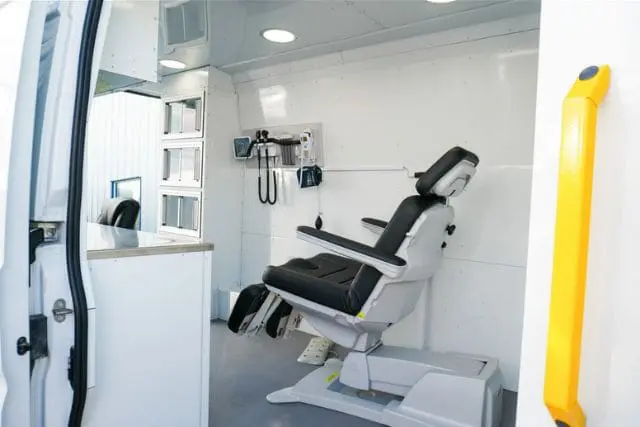
The decentralization of healthcare relies heavily on Mobile Health Vehicles (MHVs). These are not simply vans with stretchers; they are highly engineered, autonomous clinical environments designed to bring specialized medical services directly to the point of need.
Depending on the medical discipline, the structural, electrical, and HVAC requirements of the vehicle change dramatically. Here is a comprehensive breakdown of the primary types of mobile health vehicles and their engineering characteristics.
1. Types of Mobile Health Vehicles Mobile Clinics & Primary Care Vehicles
These are the most common MHVs, designed to serve as a “doctor’s office on wheels.” They are deployed for community outreach, vaccinations, occupational health, and general triage in underserved areas.
- Platform Basis: Typically built on agile van platforms (e.g., Mercedes-Benz Sprinter, Ford Transit) or mid-sized box trucks.
- Clinical Layout: Divided into a reception/waiting area and a private consultation room equipped with an examination table.
- Key Equipment: Diagnostic wall transformers (ophthalmoscopes/otoscopes), vital sign monitors, Point-of-Care Testing (POCT) kits, and secure pharmaceutical storage.
- Engineering Focus: Rapid deployment, urban maneuverability, and patient privacy.
2. Mobile Dental Clinics
Bringing oral healthcare to schools, rural communities, and corporate campuses. These units require specialized plumbing and compressed air systems.
- Platform Basis: Large box trucks (Type I), buses, or RV platforms to accommodate multiple operatory stations.
- Clinical Layout: Features one to three fully functional dental operatories, a sterilization center, and a waiting area.
- Key Equipment: Electromechanical dental chairs, integrated intraoral digital X-rays, medical-grade air compressors, suction systems, and autoclaves.
- Engineering Focus: Heavy-duty water management (fresh and grey water tanks) and vibration isolation to protect sensitive dental handpieces and imaging sensors.
3. Mobile Diagnostic & Imaging Vehicles (Mammography, X-Ray, CT)
These heavy-duty units are critical for early disease detection, bringing hospital-grade imaging to remote populations.
- Platform Basis: Heavy-duty trucks or 53-foot semi-trailers, often requiring hydraulic leveling outriggers to stabilize the imaging equipment.
- Clinical Layout: A reception/changing area separated from the main imaging suite by lead-shielded doors.
- Key Equipment: Digital mammography units, digital X-ray suites, or even 16-to-64 slice CT scanners.
- Engineering Focus: Radiation Shielding (lead-lined walls, floors, and ceilings), advanced climate control (to keep imaging sensors at precise temperatures), and extreme vibration dampening to prevent calibration drift during transit.
4. Mobile Laboratories (Biocontainment & Analytical)
Used for epidemiological surveillance, infectious disease outbreak response, or environmental testing.
- Platform Basis: Box trucks or ISO shipping containers.
- Clinical Layout: Can range from standard analytical workspaces to multi-room environments with interlocking pass-through airlocks.
- Key Equipment: Class II or III Biosafety Cabinets (BSC), Real-Time PCR thermocyclers, centrifuges, and incubators.
- Engineering Focus: Strict HVAC and Airflow Control. BSL-2 and BSL-3 labs require negative pressure environments and HEPA-H14 filtration (often paired with UV-C sterilization) to prevent the escape of airborne pathogens.
5. Mobile Blood Donation Vehicles
Essential for maintaining national blood bank reserves, these vehicles are deployed to public squares, universities, and corporate events.
- Platform Basis: 12-meter to 14-meter coaches/buses or expandable semi-trailers to handle high donor throughput.
- Clinical Layout: Unidirectional flow featuring registration, private medical screening booths, a multi-chair phlebotomy zone, and a recovery lounge.
- Key Equipment: Motorized donor chairs (with emergency Trendelenburg positioning), automated blood tube sealers, and medical-grade blood bank refrigerators (+4°C).
- Engineering Focus: Cold Chain Integrity. The vehicle requires robust, redundant power systems (generators and heavy-duty battery banks) to ensure the blood refrigerators never lose power, even if the vehicle engine is turned off.
6. Mobile Surgery & Expandable Field Hospitals
The apex of mobile healthcare engineering, designed for disaster relief, military operations, or expanding hospital capacity.
- Platform Basis: Heavy-duty semi-trailers equipped with synchronized dual-side hydraulic expansion systems.
- Clinical Layout: Upon arrival, the trailer expands to triple its floor space, creating full-scale Operating Rooms (OR), Intensive Care Units (ICU), or high-capacity triage centers.
- Key Equipment: Operating tables, anesthesia workstations, surgical lighting, and central medical gas manifolds.
- Engineering Focus: ISO 5 Cleanroom Standards. These units feature laminar airflow over the surgical table, positive pressure environments, and fully autonomous life-support systems (water purification, triple-redundant power generation) for “Black Start” capabilities in disaster zones.