
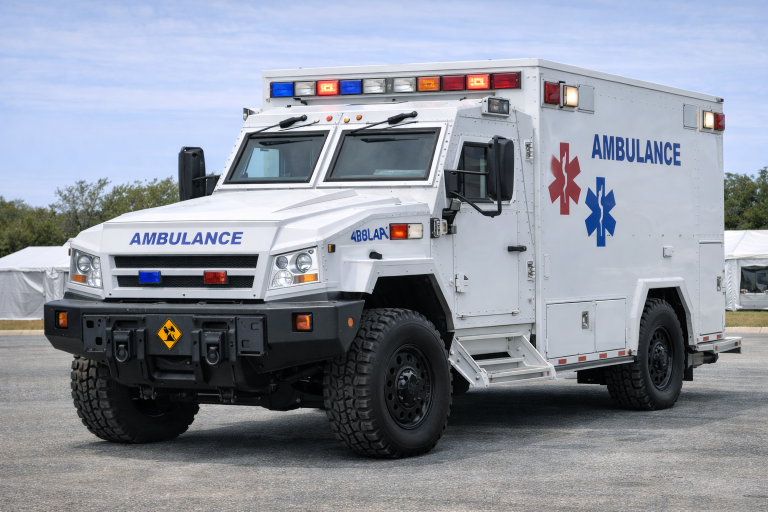
In regions where security is compromised, a standard medical response is impossible. The Ambulance Blindada (Armored Ambulance) is a specialized tactical vehicle engineered to provide a “safe haven” for patients and paramedics. Designed to withstand bullets, shrapnel, and explosive blasts, these vehicles ensure that life-saving emergency medical services (EMS) never stop—even in the most hostile environments on earth.
What is an Ambulance Blindada?
An Ambulance Blindada is an armored medical unit that bridges the gap between a military personnel carrier and a high-end mobile ICU. Whether built on a Toyota Land Cruiser 300, Ford F550, or a custom infinity chassis, every component is reinforced to meet international ballistic standards (such as CEN B6 or B7).
These vehicles are essential for mission-critical operations where medical teams must enter “hot zones” during armed conflicts, terrorist threats, or violent civil unrest.
Key Tactical Features:
- Advanced Ballistic Armor: Reinforced with laboratory-tested steel and multi-layered bullet-resistant glass.
- Explosion-Resistant Chassis: A protected undercarriage designed to deflect blast waves from mines or IEDs.
- Run-Flat Technology: Equipped with heavy-duty tires that remain functional even after taking multiple hits.
- Off-Road Supremacy: High-clearance 4×4 systems allow navigation through rubble-strewn streets and rugged terrains.
- Full Medical Suite: Integrated oxygen systems, ventilators, and intensive care equipment secured for high-speed tactical maneuvers.
Where is the Ambulance Blindada Utilized?
The versatility of the Ambulance Blindada makes it the primary choice for governments, NGOs, and defense units globally:
- Conflict & War Zones: Safely evacuating wounded personnel under enemy fire.
- Civil Unrest & Social Events: Protecting medical staff during riots, political protests, or high-risk public gatherings.
- Disaster Relief: Navigating dangerous debris in the aftermath of earthquakes or industrial accidents.
- Infectious Disease Transport: Providing a secure, isolated environment for transporting high-risk patients in unstable regions.
Technical Specifications & Safety Standards
Every Ambulance Blindada is a feat of engineering, ensuring that the heavy armoring does not compromise medical performance.
- 360° Protection: Complete coverage of the engine bay, fuel tank, and battery to prevent vehicle immobilization.
- Night Vision & Thermal Imaging: Allowing medical teams to operate discreetly or navigate in low-visibility combat zones.
- Advanced Communication: Integrated GPS and satellite link-ups for constant contact with command centers.
- Custom Interior Layouts: Ergonomically designed to maximize space for up to two litters (stretchers) and multiple medical attendants.
[Table: Armor Level Comparison] | Protection Level | Threat Resistance | Typical Application | | :— | :— | :— | | CEN B6 | 7.62x51mm (Assault Rifles) | High-risk urban & border patrol | | CEN B7 | Armor-Piercing Rounds | Active war zones & front lines | | STANAG Level 2 | Mine & Fragment Protection | Military medical evacuation |
Pricing and Customization
The Ambulance Blindada price reflects the complexity of the armoring process and the medical technology integrated. Costs are influenced by:
- Chassis Choice: Luxury SUVs vs. heavy-duty commercial truck platforms.
- Ballistic Level: The thickness and material of the armor plating (e.g., BR6 vs. BR7).
- Medical Equipment: Standard life support vs. advanced field surgical kits.
By choosing a customized Ambulance Blindada, organizations can ensure they have the exact level of protection and medical capability required for their specific theater of operation.
Protect Your Frontline Heroes
We specialize in the design and manufacture of world-class armored ambulances and tactical medical vehicles. Let us help you build a fleet that is as resilient as the teams who operate them.
Would you like a detailed technical comparison of our Toyota Land Cruiser vs. Ford F550 armored ambulance configurations?