
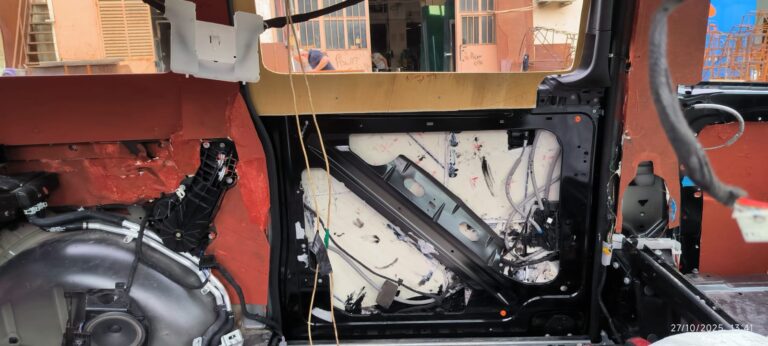
Executive Summary: The Quantum Leap in CIT Security Technology
Armour Solutions for CIT Industry; The Cash-in-Transit industry stands at a technological crossroads where traditional armor systems are converging with cutting-edge materials science, artificial intelligence, and adaptive protection technologies. This comprehensive analysis explores both current advanced solutions and emerging next-generation systems that will define CIT protection for the coming decade. As threat sophistication escalates—ranging from coordinated multi-vehicle assaults to electronic warfare tactics—the armor solutions must evolve beyond passive ballistic protection to become intelligent, responsive systems.
Part 1: Armour Solutions for CIT Industry Advanced Material Science in CIT Armor
1.1 Beyond Traditional Composites: Next-Generation Materials
Nanostructured Armor Systems:
text
Material Class          Composition                  Advantage over Traditional   Cost Multiplier
-----------------       --------------------        --------------------------   ---------------
Graphene-Reinforced     Graphene platelets in      30% weight reduction,        3-5x
Composites             polymer matrix              enhanced multi-hit capability
Carbon Nanotube        Aligned CNT fibers in       Superior energy absorption,  4-7x
Armor                  epoxy                       electrical conductivity
Metamaterial           Engineered periodic         Frequency-selective armor,   5-8x
Surfaces               structures                  radar/IED signal disruption
Liquid Armor           Shear-thickening fluids     Flexibility until impact,    2-3x
(Smart Fluids)         with silica nanoparticles  then instant hardening
High-Entropy Alloys (HEAs) for Critical Zones:
- Composition: Complex mixtures of 5+ principal elements (Cr, Mn, Fe, Co, Ni, etc.)
- Properties: Exceptional strength-to-weight ratio (1.5-2x traditional steel)
- Applications: Door hinge reinforcements, safe door structures, mounting brackets
- Cost: €150-€250 per kg (vs €5-€15 for standard ballistic steel)
Transparent Armor Evolution:
Current State vs. Next-Generation:
text
Parameter              Current (VR7)               Next-Generation (2025+)
-----------            --------------------        ----------------------------
Thickness              60-70mm                     35-45mm
Weight                 120-140kg/windshield       65-85kg/windshield
Materials              Glass/Polycarbonate        ALON/Spinel ceramics
Multi-hit capability   3 rounds @ 10m             5+ rounds @ 10m
Additional features    Heating elements           Electrochromic, embedded displays
Cost per m²           €8,000-€12,000             €15,000-€25,000
ALON (Aluminum Oxynitride) Windows:
- 85% as hard as sapphire
- 3x stronger than traditional ballistic glass at same thickness
- Can be produced in curved configurations
- Currently limited to military/special applications (cost-prohibitive for most CIT)
1.2 Adaptive & Reactive Armor Systems
Electrorheological Fluid Armor:
- Principle: Fluid viscosity increases dramatically under electric field
- Configuration: Fluid-filled cells between armor layers
- Response time: <5 milliseconds from threat detection to hardening
- Energy requirement: 10-20kV across 2mm gap
- Status: Laboratory proven, entering commercial development
Shape Memory Polymer Armor:
- Self-healing capability after projectile impact
- Can change shape to optimize protection angles
- Thermal or electrical activation
- Expected commercial availability: 2026-2028
Part 2: Integrated Protection Architecture
2.1 Multi-Layered Defense Approach
Contemporary Advanced CIT Vehicle Protection Stack:
text
Layer 1: Detection & Deterrence (Pre-engagement)
- 360° LIDAR with AI threat classification
- Acoustic gunshot detection system
- Automated deterrent systems (smoke, sound)
- Visible deterrent signaling (strobe patterns)

Layer 2: Non-Penetrative Deflection (0-50m)
- Non-lethal directed energy systems
- Electromagnetic pulse for disabling electronics
- High-intensity strobe/laser dazzlers
- Slippery surface deployment

Layer 3: Reactive Armor (0-10m)
- Explosive reactive armor (ERA) tiles (miniaturized)
- Electric reactive armor
- Dynamic armor plate adjustment

Layer 4: Passive Ballistic Protection (Direct contact)
- Advanced composite armor (VR7+)
- Ceramic-faced modular panels
- Transparent armor systems

Layer 5: Containment & Survival (Post-penetration)
- Spall liners with Kevlar®/Dyneema®
- Fire suppression systems
- Medical response automation
- Crew communication/beacon systems
2.2 Intelligent Armor Management Systems
Armour Solutions for CIT Industry Smart Panel Technology:
- Embedded Fiber Optics: Damage assessment through signal attenuation
- Piezoelectric Sensors: Impact location and energy measurement
- Capacitive Sensing: Detection of tampering or cutting attempts
- Wireless Health Monitoring: Continuous structural integrity assessment
Central Armor Management Computer:
- Real-time protection status dashboard
- Predictive maintenance scheduling
- Threat database with adaptive response protocols
- Integration with vehicle dynamics for optimal protection orientation
Part 3: Specialized CIT Vehicle Configurations
3.1 High-Risk Value Transport (HRVT) Solutions
Dedicated HRVT Vehicle Specifications:
text
Base Platform:            Mercedes-Benz Sprinter 4x4 519 CDI
                         or Ford Transit AWD Custom
Protection Level:        VR7+ with STANAG 4569 Level 2 equivalency
Engine Performance:      250+ HP, 600+ Nm torque
                         (0-100 km/h: <12 seconds despite 1800kg armor)
Safe Capacity:           CEN VI (explosive resistant, 90+ minutes)
                         with multiple internal compartments
Electronic Suite:        Full spectrum monitoring
                         (RF, acoustic, seismic, visual)
Countermeasures:         GPS anti-jamming, EMP hardening
                         Drone detection and mitigation
Communication:           Satellite (Iridium/Starlink) + cellular + mesh network
Autonomous Features:     Limited self-driving for extraction scenarios
                         Remote operation capability
Cost Framework:          Base vehicle: €65,000-€85,000
                         Armor package: €85,000-€120,000
                         Electronic systems: €40,000-€60,000
                         Total: €190,000-€265,000
3.2 Discreet CIT Solutions Armour Solutions for CIT Industry
Undercover Armor Systems:
- Thin-Profile Armor: VR4-VR5 protection in <15mm thickness
- Concealed Transparent Armor: Visually identical to factory glass
- Modular Protection: Rapid deployment of additional panels when threat increases
- Examples:
- Audi A6 Allroad with discreet VR5 protection
- Volkswagen Multivan with hidden VR4 compartment armor
- Electric vehicles (Tesla Model X) with integrated battery protection
Part 4: Emerging Threat-Specific Solutions
4.1 Counter-IED & Explosive Protection
Under-Vehicle Protection Systems:
text
Technology             Protection Level            Weight Penalty   Cost
-----------            -----------------           -------------    ------
V-Hull Design         Redirects blast waves       150-200kg        €8,000-€12,000
Ballistic Undercarriage STANAG 2a (6kg mine)      250-350kg        €12,000-€18,000
Explosive Reactive    Neutralizes shaped charges  80-120kg         €15,000-€25,000
Armor (Underbelly)
Electronic Counter-   Disrupts initiation signals Minimal          €5,000-€8,000
IED Systems
Blast Mitigation Seating:
- Hydraulic or pneumatic dampening systems
- 6-point harness with quick release
- Integrated head and neck support
- Shock-absorbing floor coupling
4.2 Counter-Drone & Electronic Warfare Protection
RF/Electronic Armor:
- Faraday Cage Integration: Complete vehicle electromagnetic shielding
- GPS Anti-Spoofing: Multi-constellation, encrypted receivers
- Communication Hardening: Frequency-hopping, encrypted mesh networks
- Drone Detection: RF, acoustic, and visual drone identification
- Counter-Drone: Directed RF jamming, net deployment systems
4.3 Fire & Environmental Protection
Advanced Fire Suppression Systems:
- Aqueous Film-Forming Foam (AFFF): Rapid fuel fire suppression
- Halotron/Clean Agent: Electronic equipment-friendly suppression
- Engine Compartment: Automated detection and suppression
- Crew Compartment: Manual and automatic systems
- External Fire Protection: Coatings and sprinkler systems for Molotov cocktails
Climate Adaptive Armor:
- Phase-change materials for thermal management
- Self-cleaning hydrophobic coatings
- Corrosion-resistant treatments for maritime environments
- UV-stabilized composites for high-sun regions
Part 5: Cost-Benefit Analysis & Implementation Strategy
5.1 Total Cost of Advanced Protection
Advanced CIT Vehicle Economic Model:
text
Cost Component                  Standard CIT (VR6)   Advanced CIT (VR7+)    Premium/Discreet
--------------------------     -------------------   --------------------   ----------------
Base Vehicle                   €45,000-€60,000      €65,000-€90,000        €80,000-€120,000
Ballistic Protection           €40,000-€60,000      €85,000-€120,000       €60,000-€90,000*
Transparent Armor              €12,000-€18,000      €25,000-€40,000        €20,000-€35,000
Safe/Vault System              €15,000-€25,000      €30,000-€50,000        €20,000-€40,000
Electronic Security            €8,000-€15,000       €40,000-€60,000        €25,000-€45,000
Mechanical Upgrades            €5,000-€10,000       €12,000-€20,000        €8,000-€15,000
Certification/Testing          €3,000-€6,000        €8,000-€15,000         €5,000-€10,000

Total Investment              €128,000-€194,000     €265,000-€395,000      €218,000-€355,000

Operational Cost Increase      25-35%               40-60%                 30-45%
Maintenance Cost Increase      30-50%               60-100%               40-70%
Expected Service Life          8-10 years           10-12 years           8-10 years
Residual Value (% of cost)    40-50%               50-60%                45-55%

*Lower cost for discreet due to reduced coverage area
5.2 ROI & Risk Mitigation Justification
Insurance Premium Reductions:
- VR7 protection: 25-40% lower premiums than VR6
- Advanced electronic systems: Additional 15-25% reduction
- Certified counter-IED protection: 30-50% reduction in war-risk premiums
Operational Benefits:
- Extended operational areas (higher-risk zones)
- Reduced security escort requirements
- Higher-value cargo capacity per trip
- Improved crew retention (safety perception)
Incident Cost Avoidance:
- Average CIT robbery loss: €150,000-€500,000+
- Vehicle replacement cost after attack: €100,000-€300,000
- Legal/liability costs: Variable but potentially millions
- Reputational damage: Incalculable but significant
Part 6: Implementation Roadmap & Best Practices
6.1 Phased Modernization Approach
Phase 1: Assessment & Planning (Months 1-3)
- Threat analysis specific to operational regions
- Current fleet vulnerability assessment
- Cost-benefit analysis for different protection levels
- Regulatory compliance review
Phase 2: Pilot Program (Months 4-9)
- 2-3 vehicles upgraded to advanced protection
- Crew training on new systems
- Operational procedure development
- Performance data collection
Phase 3: Fleet Rollout (Months 10-24)
- Prioritized vehicle replacement/upgrade
- Staggered implementation to maintain operations
- Supplier qualification and contracting
- Quality control implementation
Phase 4: Continuous Improvement (Ongoing)
- Technology refresh cycles (3-5 years)
- Threat intelligence integration
- Performance monitoring and optimization
- Crew feedback incorporation
6.2 Training & Human Factor Integration
Advanced System Training Curriculum:
- Technical Familiarization: 40 hours on system operation
- Tactical Employment: 80 hours on optimal use scenarios
- Emergency Procedures: 40 hours on system failure responses
- Maintenance Awareness: 24 hours on basic troubleshooting
Simulation-Based Training:
- Virtual reality attack scenarios
- Tabletop exercises for command decisions
- Live-fire demonstrations (showing armor effectiveness)
- Electronic warfare scenario training
Part 7: Future Directions & Research Frontiers Armour Solutions for CIT Industry
7.1 Horizon Technologies (2026-2030)
Energy-Absorbing Metamaterials:
- Frequency-specific vibration damping
- Impact energy conversion to electrical storage
- Self-organization for optimal protection geometry
Biomimetic Armor Systems:
- Nacre (mother-of-pearl) inspired layered structures
- Turtle shell geometry for optimal protection distribution
- Spider silk protein composites for flexible armor
Quantum-Based Threat Detection:
- Quantum radar for seeing behind obstacles
- Quantum encryption for unbreakable communications
- Quantum sensors for IED component detection
7.2 Autonomous CIT Systems
Robotic CIT Vehicles:
- Unmanned operation in high-risk zones
- Human oversight from secure locations
- Swarm technology for convoy operations
- Self-driving extraction under fire
Integrated Logistics Networks:
- Armored autonomous transfer between vehicles
- Aerial drone support for route clearance
- Blockchain-based cargo tracking
- AI-predicted threat avoidance routing
Conclusion: The Strategic Imperative of Advanced Protection
The CIT industry’s evolution toward advanced armor solutions represents not merely a technological upgrade but a strategic necessity. As criminal methodologies become increasingly sophisticated—incorporating intelligence gathering, electronic warfare, and coordinated multi-modal attacks—the traditional reactive armor paradigm proves insufficient.
The most significant insights from current advanced systems and future developments include:
- Integration Over Isolation: Advanced armor must function as part of an integrated protection ecosystem encompassing detection, deterrence, deflection, and defense.
- Adaptive Intelligence: Future systems will increasingly incorporate real-time threat assessment and adaptive response, changing protection characteristics based on immediate threats.
- Cost-Performance Revolution: While advanced systems command premium prices (€85,000-€120,000+ for armor packages alone), their total lifecycle value—through extended service life, reduced insurance costs, and prevented losses—often justifies the investment within 2-3 years for high-risk operations.
- Human-Machine Symbiosis: The most effective protection combines advanced materials with trained personnel who understand system capabilities and limitations.
- Regulatory Anticipation: Forward-looking CIT operators are implementing protection that exceeds current regulations, anticipating future standards and insurance requirements.
For CIT operators, the decision to invest in advanced armor solutions represents a fundamental choice about risk tolerance, operational scope, and long-term viability. Those embracing these technologies gain access to higher-value contracts, expanded operational territories, and enhanced crew safety—creating competitive advantages that extend far beyond the immediate ballistic protection benefits.
Armour Solutions for CIT Industry; The future of CIT protection lies not in thicker armor, but in smarter, more responsive systems that prevent attacks before they occur, survive those that do happen, and ensure operational continuity regardless of threats faced. This paradigm shift from passive protection to active defense represents the true next generation of CIT security.