
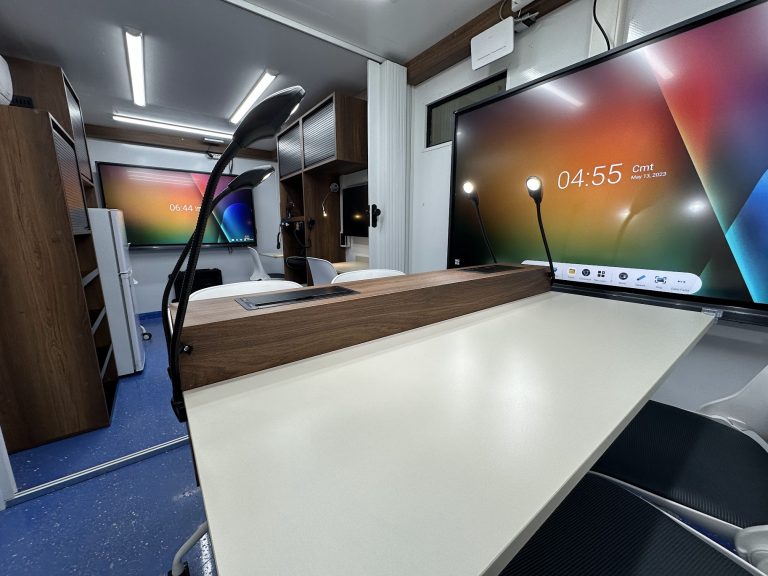
Military Mobile Communications Vehicles (MMCVs) represent the core of tactical and strategic C4ISR mobility. These specialized platforms enable modern network-centric warfare by providing secure, resilient, and rapidly deployable communications infrastructure across contested environments. This analysis covers current systems, technical architectures, and emerging technologies transforming military communications on the move.
Part 1: Classification and Mission Profiles
1.1 Vehicle Categories by Echelon
| Category | Platform Examples | Primary Role | Range |
|---|---|---|---|
| Light Tactical | JLTV, HMMWV, Land Cruiser 70 | Battalion-level command, forward presence | 15-50 km |
| Medium Tactical | FMTV, Unimog, Iveco LMV | Brigade-level command, regional nets | 50-300 km |
| Heavy Tactical | HEMTT, MAN HX, Tatra | Division-level, strategic links | 300-1000+ km |
1.2 Strategic Systems
- SATCOM Vehicles: AN/TSC-154, MMSV
- Tropospheric Scatter: AN/TRC-170
- Microwave Relay: Mobile LOS/UHF stations
- Cyber/EW Platforms: Integrated SIGINT/EW
1.3 Key Standards (STANAGs)
| Standard | Purpose |
|---|---|
| STANAG 4203 | NATO tactical communications |
| STANAG 5066 | HF radio data profile |
| STANAG 4538 | Tactical SATCOM |
Part 2: Technical Architecture
2.1 Communications Subsystems
| Band | Systems | Range | Encryption |
|---|---|---|---|
| HF (3-30 MHz) | AN/PRC-150, Falcon III | 30-5000 km | AES-256, HAIPE |
| VHF (30-88 MHz) | SINGGARS, Bowman | 5-50 km | KY-57/58 |
| UHF (225-400 MHz) | Have Quick, DAMA | 300 km | ANDVT, KG-84 |
| SHF (1-40 GHz) | WGS terminals | Global | KG-250 |
Software-Defined Radio (SDR):
- Platforms: AN/PRC-117G, AN/PRC-163
- Capabilities: Simultaneous voice/data/video, cognitive radio
- Waveforms: SRW, WNW, MUOS-compatible
2.2 Antenna Systems
| Type | Deployment | Gain | Use |
|---|---|---|---|
| Whip | 2-5 min | 3-10 dBi | Immediate |
| Mast (12-30m) | 10-30 min | 6-18 dBi | Extended |
| SATCOM dish | 5-15 min | 20-40 dBi | Strategic |
| Conformal | Permanent | 5-15 dBi | COTM, stealth |
Advanced:
- Phased arrays (AESA)
- MIMO (4×4, 8×8)
- LPI/LPD, anti-jam nulling
2.3 Power & Environmental
| Source | Specification |
|---|---|
| Primary | 10-30 kW diesel generator |
| Secondary | Li-ion batteries (8-24h silent) |
| Tertiary | Solar, fuel cells |
- EMI/RFI: MIL-STD-461 compliant
- Climate: MIL-STD-810 (-32°C to +52°C)
- NBC: Overpressure, filtration
- Acoustic: Noise reduction for covert ops
Part 3: Network & Cybersecurity
3.1 Tactical Network Topologies
| Network Tier | Data Rate | Latency | Protocols |
|---|---|---|---|
| Tactical Edge (MANET) | 64 Kbps-2 Mbps | 50-200 ms | SRW, 4G tactical |
| Tactical Backbone | 2-100 Mbps | 20-100 ms | WNW, IP/MPLS |
| Strategic Gateway | 100 Mbps-1 Gbps | <100 ms | WGS, commercial |
Next-Gen:
- Cognitive MANET (AI-driven)
- Disruption Tolerant Networking (DTN)
- Mesh networking
- 5G tactical
3.2 Cybersecurity
| Layer | Protection |
|---|---|
| Physical | TEMPEST shielding, tamper detection |
| Cryptographic | AES-256, ECC-384, quantum-ready |
| Network | HAIPE, IPsec, MACsec, zero-trust |
| Identity | PKI, MFA, biometrics |
EW Protection:
- LPI/LPD
- Frequency hopping (1000+ hops/sec)
- Spread spectrum
- Adaptive anti-jam
Part 4: Vehicle Platforms
4.1 Major Systems
| Platform | Designation | Role |
|---|---|---|
| JLTV | AN/TSC-241 | Light tactical node |
| HEMTT A4 | AN/TSC-185 | Heavy SATCOM |
| Stryker | ICV-C | Mobile command post |
| GTK Boxer | FüFuSys | European CP |
| VBMR Griffon | SIT | French command |
4.2 Interoperability Standards
- MIL-STD-188 – Communications
- JTRS – SCA compliance
- VMF – K-series messages
- Link 16 – Tactical data links
- STANAG 5525 – NATO C3 architecture
Part 5: Emerging Technologies
5.1 Satellite Evolution
| System | Type |
|---|---|
| Starlink/OneWeb | LEO constellations (military variants) |
| WGS/AEHF | MILSATCOM modernization |
| Optical links | Laser intersatellite |
5.2 Terrestrial Innovations
- AI-optimized mesh networking
- Cognitive radio (dynamic spectrum access)
- Free-space optical (10-100 Gbps)
- Drone-based relays (airborne LTE)
5.3 Quantum Technologies
| Technology | Application |
|---|---|
| QKD | Secure key exchange |
| Quantum radar | Enhanced detection |
| Post-quantum crypto | CRYSTALS-Kyber, NTRU (2025-2030) |
5.4 Autonomous Communications
| Platform | Role |
|---|---|
| UGV | Ground relay |
| UAV | Airborne relay |
| USV | Maritime node |
AI-Enhanced:
- Predictive maintenance
- ML-based QoS optimization
- Threat pattern analysis
- Real-time spectrum allocation
Part 6: Operational Employment
6.1 Deployment Phases
| Phase | Assets | Timeline |
|---|---|---|
| Initial Entry | Light vehicles | Hours |
| Follow-on | Medium/heavy systems | Days |
| Sustained | Full network | Ongoing |
Air Transport: C-130, A400M, C-17 compatible
6.2 Command Post Integration
| Type | Function |
|---|---|
| TOC | Main command facility |
| Jump CP | Rapidly relocatable node |
| Main CP | Sustained ops hub |
| Rear CP | Logistics support |
6.3 Training & Maintenance
- VR simulation training
- Live field exercises
- JITC interoperability certification
- Built-in test (BIT) diagnostics
- Predictive maintenance (IoT + ML)
- Remote satellite-linked support
Part 7: Cost Analysis
7.1 System Cost Breakdown
| Component | Cost (USD) | % |
|---|---|---|
| Base Vehicle | $150k-500k | 15-25% |
| Communications | $500k-2M | 50-65% |
| Ancillary Systems | $100k-300k | 10-15% |
| Integration & Testing | $100k-300k | 10-15% |
| Training & Support | $50k-150k | 5-8% |
| TOTAL | $900k-3.25M | 100% |
7.2 Lifecycle Costs (10 years)
| Category | Annual Cost |
|---|---|
| Operations | $200k-500k |
| Maintenance | $50k-150k |
| Upgrades | $100k-300k (every 3-5 years) |
| Training | $20k-50k per crew |
7.3 Acquisition Options
| Method | Description |
|---|---|
| FMS | Government-to-government |
| Direct Commercial | Manufacturer to military |
| OTA | Rapid prototyping |
| MOSA | Modular, upgradeable systems |
Conclusion: The Future MMCV
Military Mobile Communications Vehicles are undergoing their most significant transformation since the digitization of tactical networks.
Key Trends
| Trend | Impact |
|---|---|
| Domain Convergence | Unified space-air-ground-maritime networks |
| Cognitive Systems | AI-driven spectrum management |
| Quantum Resilience | Post-quantum crypto, QKD |
| Autonomous Ops | Reduced crew requirements |
| Commercial Integration | LEO constellations, 5G |
| Zero-Trust Security | Beyond traditional encryption |
The 2030 MMCV
The next-generation MMCV will be:
- Reduced signature: Conformal antennas, stealth
- Increased resilience: Multi-path across domains
- Enhanced mobility: Lighter, more capable
- Fully interoperable: Seamless coalition ops
Not a specialized truck with radios—a mobile data center with antennas. A processing, analysis, and communications node serving as the indispensable connective tissue of modern joint all-domain operations.
The objective remains: reliable, secure communications anywhere, anytime. But the means—software-defined, AI-enhanced, multi-domain networks—represent a fundamental shift toward decision superiority on future battlefields.
Infinity Chassis Units specializes in integrating military communications systems into tactical platforms for global defense forces.
📍 Ankara, Turkey
✉️ sales@infinitychassis.com
🌐 infinitychassis.com