
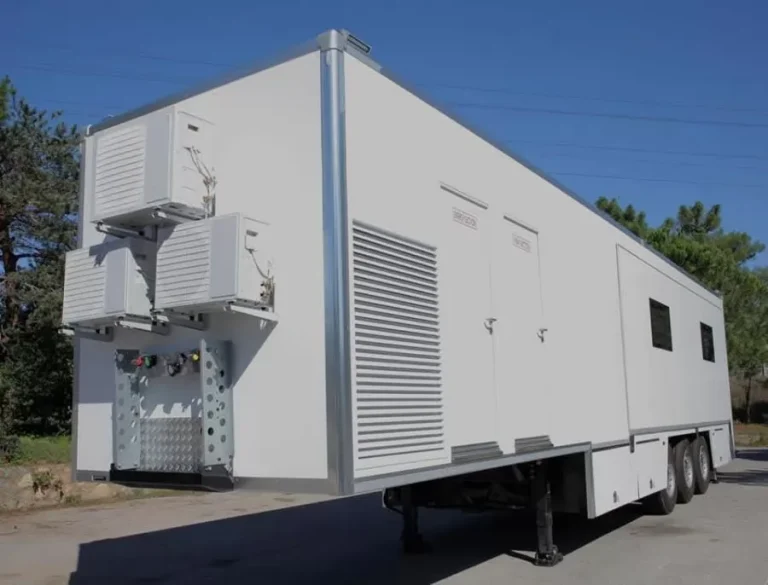
Imagine a hospital that can pack up and drive away. A place where doctors can work, surgeries can happen, and patients can be treated, but instead of being a big building stuck in one spot, it can travel to wherever help is needed most. That’s what a mobile hospital is.
Sometimes people call them mobile medical units or mobile health clinics. Whatever name you use, they serve the same purpose: bringing healthcare directly to patients instead of making patients come to them.
What Is a Mobile Hospital?
A mobile hospital is basically a healthcare facility built inside a customized truck, van, trailer, or other vehicle. It has many of the same things you’d find in a regular hospital, just on a smaller scale.
The key difference from regular hospitals is simple. Regular hospitals are fixed in one place. Patients have to travel to them. Mobile hospitals can drive to where the patients are. This makes a huge difference for people who live far from medical care or in emergencies when regular hospitals are damaged or overwhelmed.
How Mobile Hospitals Are Different
Transportable. They can drive to wherever they’re needed. This expands access to healthcare for people who might not otherwise get it.
Flexible. Their services can be tailored to specific communities and situations. A mobile hospital serving rural farming towns might look very different from one helping homeless populations in a big city.
Scalable. Mobile hospitals can send as many or as few vehicles and staff as needed. They adapt to the situation.
Streamlined. They provide targeted healthcare efficiently without running a full-scale hospital facility.
A Quick History
Mobile hospitals aren’t a new idea. They’ve been around for over a hundred years.
Back in the late 1800s, horse-drawn carriages were outfitted with medical equipment and sent to provide care to rural communities in the American West. During World War I, trucks and trains were converted into mobile hospitals to treat soldiers near battlefields in Europe.
In the 1950s and 1960s, public health organizations started using mobile hospitals to bring medical services to rural towns and neighborhoods that didn’t have good healthcare. Those early mobile units focused on things like vaccines, health screenings, and education.
Today’s mobile hospitals are much more advanced. They’re built into tractor trailers, buses, RVs, and even airplanes and helicopters. They contain state-of-the-art medical equipment like imaging machines, ICUs, and surgical suites. With telemedicine, they can connect patients and on-site staff to medical experts anywhere in the world.
What’s Inside a Mobile Hospital
Mobile hospitals typically include many of the same things you’d find in a regular hospital emergency room:
- An emergency room for urgent care
- Operating rooms for surgery
- Imaging services like X-ray and ultrasound
- A laboratory for testing
- Inpatient beds for patients who need to stay
The medical equipment inside is compact and secured for travel but fully functional. You’ll find:
- Patient stretchers and beds
- Ventilators and vital sign monitors
- Defibrillators and other emergency gear
- Surgical tools and anesthesia machines
- X-ray, ultrasound, and CT scanners
- Lab equipment like centrifuges and microscopes
- Medications, vaccines, and IV fluids
Who Works in a Mobile Hospital
Mobile hospitals have a team of medical staff similar to a standard hospital ER:
- Emergency physicians
- Nurses
- Radiology techs
- Lab techs
- Administrative staff
- Security personnel
Some larger mobile hospitals also have specialists like surgeons or cardiologists either on-site or available through telemedicine.
How Mobile Hospitals Set Up
Mobile hospitals are designed to get working fast. Most can be fully operational within a few hours of arriving at a location.
Some are built into truck trailers that can be hitched up and towed anywhere. Others use semi-permanent structures designed for quick assembly and disassembly. Some even use inflatable tents that provide flexible space and can be set up rapidly.
They come with their own generators, lighting, climate control, and other utilities. They don’t need to plug into anything. This makes them self-sufficient and able to work anywhere, even in places with no power or water.
The Good Things About Mobile Hospitals
Better access to care. Mobile hospitals can reach underserved communities and remote areas. They provide care to people who couldn’t get it before because of distance or transportation problems.
Fast disaster response. When earthquakes, floods, or storms hit, regular hospitals might be damaged or overwhelmed. Mobile hospitals can deploy quickly to disaster zones and start treating people right away.
Lower cost. Building a regular hospital costs millions and takes years. Mobile hospitals cost much less and can be ready much sooner. They offer a flexible, cost-effective way to provide healthcare, especially in places with limited resources.
Fill healthcare gaps. Mobile hospitals can service temporary needs or rotate between locations as demand changes. They bring quality medical care directly to people who need it most.
The Not-So-Good Things
Limited capacity. Mobile hospitals are compact by design. They can’t handle as many patients as a large traditional hospital. Capacity might range from just a couple beds up to about 50 beds for the biggest ones.
Need fuel and power. Mobile hospitals rely on generators and fuel. If fuel runs out or generators break down, they can’t operate. Keeping fuel supplies going in remote areas can be tricky.
Hard to keep staff. Finding qualified medical staff willing to work in remote, rough conditions isn’t easy. They live in sparse camp conditions away from family. Burnout and turnover are real problems.
Where Mobile Hospitals Get Used
Rural and Remote Areas
Mobile hospitals travel to isolated communities that don’t have good healthcare. They bring checkups, screenings, minor procedures, and telemedicine closer to people who need them.
Natural Disasters
When floods, storms, or earthquakes damage hospitals, mobile units can move in fast and start treating people. They help right after a crisis when healthcare demand jumps.
Refugee Camps
For people displaced by war or conflict, mobile hospitals deliver needed care. Since camps are temporary, mobile facilities make sense. They can shift locations as populations move.
Military Field Hospitals
Armed forces have used mobile hospitals for a long time. They care for soldiers in war zones and remote deployments. They can be transported by planes, trucks, or ships and set up quickly where needed.
Underserved Communities
Some city neighborhoods don’t have good access to healthcare either. Mobile hospitals can visit these urban healthcare deserts and provide services.
How Mobile Hospitals Are Designed
Mobile hospitals are built for portability and durability. They need to survive travel over rough roads and still work perfectly when they arrive.
Some use inflatable structures made of durable PVC. These can be expanded or contracted as needed and set up fast by a small team. They provide climate control and can isolate contagious patients.
Others are built into durable truck, van, and bus chassis or trailers. Interiors are customized based on what services they’ll offer. The vehicle frame lets them travel across land to remote locations.
Making them lightweight while keeping enough space and equipment is an engineering challenge. Interiors use compact, collapsible, and multi-purpose furniture and equipment. Everything must withstand vibrations during transport.
Famous Mobile Hospitals
Mercy Ships
Since 1978, Mercy Ships has operated the world’s largest civilian hospital ship, the Africa Mercy. This converted ship has five operating rooms and provides free healthcare along the coasts of Africa. They’ve treated over 2.8 million patients and done over 100,000 surgeries.
Nepal Mobile Health Program
Run by the Nick Simons Foundation, this program sends trucks with medical equipment to remote mountain villages in Nepal. Each mobile clinic has a doctor, nurses, and a lab technician. They’ve treated over 50,000 patients since 2016.
Emergency Field Hospitals
Various organizations have sent rapidly deployable mobile hospitals to disaster zones like the 2004 Indian Ocean tsunami. These field hospitals can be working within 48 hours of arriving, saving lives with modular tents, generators, and medical supplies.
Floating Hospitals
Some mobile clinics use ships or barges on rivers to reach hard-to-access populations living deep inland along waterways.
Airborne Hospitals
Customized aircraft like Boeing 747s have been turned into flying hospitals with operating rooms, ICUs, and patient wards. The US and some European countries operate these.
What’s Next for Mobile Hospitals
Mobile healthcare is still growing and improving. Here’s what the future might look like:
More telemedicine. Mobile hospitals will connect patients and doctors remotely even more. Remote monitoring, video consultations, and access to specialists will expand.
New medical tech. As new devices emerge, mobile hospitals can adopt them faster than big traditional hospitals. Portable diagnostic tests, AI-assisted imaging, and wearable monitors will become common.
Customizable designs. Mobile hospitals will become more modular and customizable. Standardized shipping containers will give way to more flexible modules that can be arranged for specific needs.
Electric vehicles. To be more sustainable, mobile hospitals will likely switch from diesel to electric. Some may even drive themselves, reducing labor costs and improving safety.
Growth in developing nations. Mobile hospitals have huge potential in poor countries where many people can’t get good healthcare. Aid groups will likely use them more to reach vulnerable populations.
The Bottom Line
Mobile hospitals fill an important gap in healthcare. They’re not meant to replace regular hospitals. But they do things regular hospitals can’t.
They reach people in remote places. They respond fast when disasters hit. They cost less than building permanent facilities. They adapt to whatever situation they face.
For communities without good healthcare access, for disaster zones where hospitals are destroyed, for refugee camps and military operations and rural towns, mobile hospitals bring care right where it’s needed.
They’re an innovative solution to an old problem: how to get medical help to people who can’t easily get to a doctor. And as technology improves, they’ll only get better at doing it.