
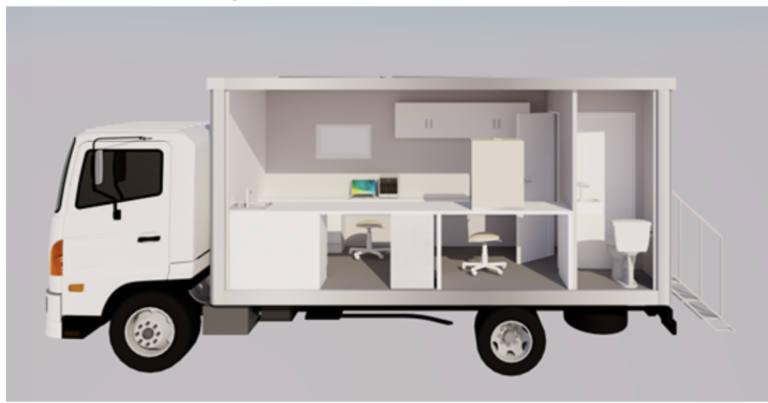
In the rapidly evolving landscape of decentralized science, deploying analytical capabilities directly to the field is no longer a luxury—it is an operational requirement. At Infinity Chassis Units (ICU), we engineer state-of-the-art mobile laboratories utilizing both Van and Truck (Box-Body) platforms.
Choosing between a van and a truck chassis is the most critical foundational decision in mobile laboratory design. The platform dictates the payload capacity, biocontainment level, instrumentation weight, and off-road capability.
Here is a comprehensive engineering breakdown of how we utilize these two distinct platforms to create world-class mobile scientific environments.
1. The Van-Based Mobile Laboratory: Agile Rapid Response
Van platforms—such as the Mercedes-Benz Sprinter, Ford Transit, and IVECO Daily—are the backbone of rapid-response scientific deployment. They are engineered for speed, urban maneuverability, and immediate point-of-care diagnostics.
1.1. Engineering Profile & Payload
- Gross Vehicle Weight Rating (GVWR): Typically ranges from 3,500 kg to 5,500 kg.
- Mobility: Exceptional turning radius and highway speeds. Available with advanced 4×4 drivetrains (e.g., Sprinter 4×4) for moderate off-road access.
- Structural Integration: We utilize the original factory steel shell, insulating it with high-density polyurethane foam and lining it with our signature Seamless ABS Vacuum-Formed Panels to create a sterile, wipe-down environment.
1.2. Primary Clinical & Scientific Applications
- Epidemiological Triage (BSL-2): Outfitted with Real-Time PCR thermocyclers and Class II Biosafety Cabinets for immediate pathogen identification.
- Environmental Screening: Perfect for municipal water quality testing or rapid soil sampling, carrying multiparameter probes and portable incubators.
- Digital Forensics: Agile enough to arrive at a crime scene alongside first responders to secure and analyze digital evidence.
2. The Truck-Based Mobile Laboratory: Heavy-Duty Analytical Power
When the scientific mission requires heavy instrumentation, multi-room biocontainment (airlocks), or prolonged off-grid autonomy in harsh environments, we step up to the Heavy-Duty Truck Platform (Type I / Box-Body).
2.1. Engineering Profile & Payload
- Platform Basis: Built on heavy-duty chassis-cabs such as the Ford F-550, Mercedes-Benz Atego, or Scania series.
- Gross Vehicle Weight Rating (GVWR): Ranges from 6,000 kg to over 15,000 kg.
- The “Box” Architecture: We manufacture a custom, independent medical module using 50mm–60mm Composite Sandwich Panels. This box is mounted to the truck chassis using elastomeric vibration isolators, protecting hyper-sensitive equipment from road shock.
2.2. Primary Clinical & Scientific Applications
- High-Level Biocontainment (BSL-3): The square dimensions of the truck box allow us to engineer dedicated “Clean” and “Dirty” zones separated by interlocking pass-through airlocks and decontamination showers.
- Industrial Geochemistry & Mining: Truck platforms have the payload capacity to safely transport heavy rock crushers, high-voltage X-Ray Fluorescence (XRF) analyzers, and large volumes of compressed carrier gases (Helium/Argon).
- Mass-Throughput Clinical Labs: Capable of housing high-capacity chemistry analyzers and hematology lines, functioning as a complete regional reference lab.
3. Universal Subsystems: The ICU Engineering Standard
Regardless of whether the laboratory is built into an agile Sprinter van or a massive F-550 truck, it must operate autonomously and flawlessly. ICU integrates identical high-performance subsystems across both platforms:
3.1. Advanced HVAC and Pressure Control
- Biocontainment: We engineer intelligent HVAC systems capable of maintaining precise Negative Pressure (to prevent pathogen escape) or Positive Pressure (to protect sensitive samples from dust contamination).
- Filtration: Integrated HEPA-H14 filtration on both inlet and exhaust, often augmented with UV-C air sterilization modules.
3.2. Redundant Power Architecture
- Primary Power: Super-silent marine-grade diesel generators (ranging from 10 kVA in vans to 40 kVA in trucks) mounted in acoustically insulated exterior compartments.
- Silent Operations: Lithium-Ion (LiFePO4) battery banks paired with 3000VA to 5000VA Pure Sine Wave inverters ensure sensitive optical equipment receives “clean” power without voltage spikes.
3.3. 10G Dynamics and Anti-Vibration
A mobile lab is a hostile environment for a Gas Chromatograph or a microscope. All heavy analytical equipment is secured to the chassis using 10G-rated custom brackets, and sensitive optics are mounted on specialized wire-rope or elastomeric vibration dampeners.
4. Technical Comparison Matrix: Van vs. Truck Laboratory
| Technical Parameter | Van Platform (e.g., MB Sprinter) | Truck Box-Body (e.g., Ford F-550) |
| Max Payload Capacity | Approx. 1,000 kg – 1,500 kg | Approx. 3,500 kg – 6,000+ kg |
| Interior Volume | 10m³ to 14m³ | 18m³ to 28m³ |
| Biocontainment Max | Up to BSL-2 (Compact) | Up to BSL-3 (With dedicated airlocks) |
| Vibration Isolation | Standard chassis suspension | Independent Elastomeric Module Mounts |
| Deployment Speed | Immediate (Highway speeds, urban agile) | Moderate (Heavy transport logistics) |
| Power Autonomy | 12 to 24 Hours | 48 to 72+ Hours |
E-Tablolar’a aktar
Engineering Your Scientific Fleet
Whether your mission dictates the agile, rapid-response capabilities of a Mercedes Sprinter or the unyielding heavy-duty performance of an armored truck box-body, Infinity Chassis Units provides factory-direct, turnkey laboratory solutions. We bridge the gap between automotive engineering and rigorous scientific compliance.
Contact Infinity Chassis Units today:
- Web: www.infinitychassis.com
- Email: sales@infinitychassis.com
- Phone/WhatsApp: +90 555 104 06 48