Ambulance Price by Type:; When purchasing an ambulance, understanding the different vehicle types is crucial—not just for functionality and compliance, but for budgeting. The three main classifications—Type 1, Type 2, and Type 3—serve distinct purposes and come with different price points, equipment standards, and construction methods.
This guide breaks down each type, its uses, specifications, and provides clear pricing expectations to help you make an informed investment.
What Are Ambulance Types? Ambulance Price by Type
Ambulance types are standardized classifications based on the vehicle’s chassis and the design of its patient compartment. These standards (primarily following U.S. KKK-A-1822 specifications or European EN 1789) ensure that emergency medical vehicles meet minimum safety, size, and equipment requirements.
Quick Comparison Table
| Feature | Type 1 Ambulance | Type 2 Ambulance | Type 3 Ambulance |
|---|---|---|---|
| Chassis & Body | Truck chassis with separate modular box | Van chassis (cutaway or raised roof) | Van chassis (cutaway) with integrated module |
| Best For | ALS, rural, long-distance, rugged terrain | BLS, patient transport, urban mobility | ALS, critical care, versatile operations |
| Typical Price | ~$75,000 USD (base) | ~$83,000 USD (base) | ~$92,500 USD (base) |
| Key Advantage | Durability & large interior space | Maneuverability & cost-efficiency | Spacious cabin with easy cab access |
Note: Prices are for a new, base-model ambulance with essential BLS (Basic Life Support) equipment. Fully-equipped ALS (Advanced Life Support) or specialty units cost significantly more.
Type 1 Ambulance: The Heavy-Duty Responder
Approximate Base Price: $75,000 USD
What is a Type 1 Ambulance?
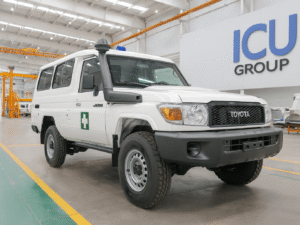
A Type 1 ambulance is built on a heavy-duty truck chassis (like a Ford F-550 or Chevrolet 4500). The key characteristic is its separate, modular patient compartment (often called a “box”) mounted onto the chassis. There is typically a physical barrier or small pass-through between the driver’s cab and the patient area.
Specifications & Common Uses:
- Chassis: Truck chassis (e.g., Ford F-Series, Chevrolet Silverado 4500+).
- Body: Separate, modular patient compartment.
- Drivetrain: Often available in 4×4 for off-road capability.
- Best For:
- Advanced Life Support (ALS)
- Rural areas and long-distance transfers
- Services requiring maximum interior space for equipment and multiple providers
- Fire departments (as they often use similar truck chassis)
Price Factors for Type 1:
- Higher Cost Drivers: 4×4 capability, diesel engine, large modular box, high-power electrical systems.
- Why it’s $75k (Base): The truck chassis itself is expensive, and the modular body requires significant custom fabrication and mounting. It’s built for durability over high mileage and rough terrain.
Type 2 Ambulance: The Agile Van – Ambulance Price by Type
Approximate Base Price: $83,000 USD
What is a Type 2 Ambulance?
A Type 2 ambulance is a modified van. It uses a standard van chassis (like a Ford Transit, Mercedes Sprinter, or Ram ProMaster) with a raised roof to allow medical personnel to stand inside. The conversion is integrated into the original van body; there is no separate modular box.
Specifications & Common Uses:
- Chassis: High-roof van chassis.
- Body: Original van body with modified interior.
- Drivetrain: Typically front-wheel or rear-wheel drive.
- Best For:
- Basic Life Support (BLS) and non-emergency patient transport
- Dense urban environments (better maneuverability and parking)
- Hospital discharge services, nursing home transfers
- Where lower initial cost and operating expense are priorities
Price Factors for Type 2:
- Higher Cost Drivers: High-roof van option, advanced climate control for the larger cabin.
- Why it’s $83k (Base): While the van chassis may be cheaper than a truck, the raised roof conversion is a complex and costly process. The entire interior requires custom medical-grade fabrication within the constraints of the original van body.
Type 3 Ambulance: The Hybrid Workhorse
Approximate Base Price: $92,500 USD
What is a Type 3 Ambulance?
A Type 3 ambulance combines elements of Type 1 and Type 2. It is built on a van cutaway chassis (the front section of a van, like a Ford E-450 cutaway), but features a separate, modular patient compartment that is integrated more seamlessly than a Type 1. A large, walk-through passageway connects the cab to the patient area.
Specifications & Common Uses:
- Chassis: Van cutaway or cab chassis.
- Body: Separate modular body, but with integrated styling to match the cab.
- Drivetrain: Similar to Type 1, often robust.
- Best For:
- Advanced Life Support (ALS) and Critical Care
- Paramedic services and hospital-based fleets
- Services that need the spacious, modular box of a Type 1 but prefer the integrated cab access of a van
- A versatile balance between interior space and drivability
Price Factors for Type 3:
- Higher Cost Drivers: Combined cost of a cutaway chassis and a custom modular body, complex electrical integration between cab and box.
- Why it’s $92.5k (Base): It often carries the highest base price because it involves purchasing a specialized cutaway chassis and building a modular body, combining the major fabrication costs of both other types.
What Do “Base” Prices Include?
The prices listed ($75k, $83k, $92.5k) are for a new, minimally-equipped ambulance. A “base” configuration typically includes:
- The vehicle chassis with ambulance preparation package
- Basic interior cabinetry and squad bench
- Essential warning lights and siren
- Basic electrical system with inverter
- Heating and air conditioning
- A standard cot fastener
- Minimal medical equipment (often just an oxygen unit and basic first aid kit)
What Drives the Final Price Up? (Beyond Base)
The final price of any ambulance type can easily double based on your needs:
- Medical Equipment Level:
- BLS Upgrade: +$15,000 – $30,000 (AED, suction, immobilization, monitoring)
- ALS/ Critical Care: +$40,000 – $100,000+ (Defibrillator/ monitor, ventilator, infusion pumps, video laryngoscope, blood fridge).
- Vehicle Specifications:
- Diesel engine, 4×4 drivetrain, heavy-duty suspension.
- Upgraded electrical system with larger inverter and generator.
- Customization & Compliance:
- Specialty interiors for neonatal, bariatric, or infectious disease control.
- Specific federal (KKK) or state certifications.
- Communication packages (radios, data terminals).
Example Total Cost: A fully-equipped Type 3 ALS ambulance with advanced monitoring and communication could realistically cost $180,000 – $250,000+.
Conclusion: Choosing Based on Need and Budget – Ambulance Price by Type
- Choose Type 1 ($75k+) if you need maximum durability, space, and capability for tough environments or long-distance ALS.
- Choose Type 2 ($83k+) if your primary needs are urban BLS transport, patient moves, and you value lower operating costs and maneuverability.
- Choose Type 3 ($92.5k+) if you need an optimal balance—the spacious, customizable module of a Type 1 with better cab access for ALS and critical care operations.
Always remember: the “sticker price” is just the beginning. Work closely with a reputable manufacturer or dealer to spec out a vehicle that includes all the necessary medical equipment and customization for your service, and you’ll have a clear picture of the true total investment.