Mercedes Ambulance Types
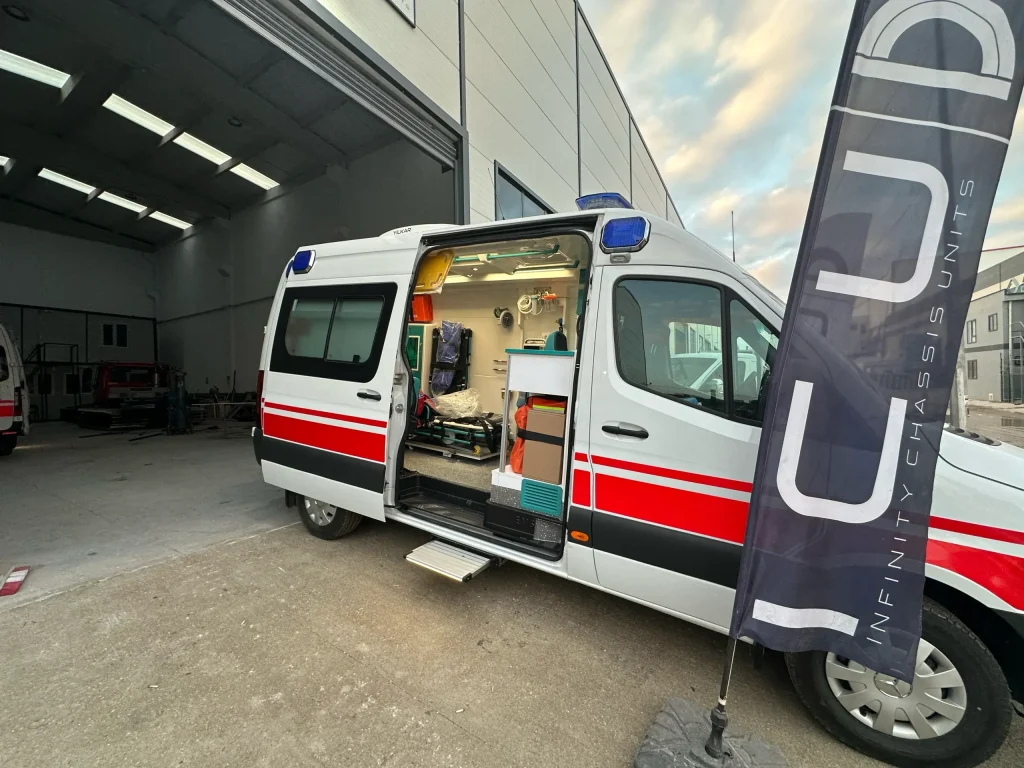
By Infinity Chassis Engineering Team – ISO 9001:2015 & EN1789 Certified Mercedes Sprinter Ambulance Types Manufacturer
Introduction
Mercedes-Benz has established itself as a global leader in commercial vehicle manufacturing, and its platforms have become the preferred choice for ambulance conversions worldwide. From the agile Sprinter van to the legendary Unimog off-road truck, Mercedes offers a chassis for every emergency medical service (EMS) requirement .
This comprehensive guide covers all Mercedes ambulance types, their specifications, and their ideal applications to help you make an informed procurement decision.
Mercedes Ambulance Classification System
Mercedes ambulances are typically classified according to two systems:
By Chassis Type:
-
Van-based ambulances (Sprinter, Vito)
-
Box/module ambulances (heavy-duty chassis)
-
Truck-based ambulances (Unimog, Zetros)
By Medical Capability (EN1789 Standard):
-
Type A (Patient Transport Ambulance) – A1 and A2 subtypes
-
Type B (Emergency Ambulance) – Basic Life Support (BLS)
-
Type C (Mobile ICU/CCU) – Advanced Life Support (ALS)
Mercedes Sprinter Ambulance – The Global Standard
The Mercedes Sprinter is the world’s most popular ambulance platform. Its combination of maneuverability, interior space, and fuel efficiency makes it the first choice for EMS providers globally .
Sprinter-Based Ambulance Types
Type II Ambulance (Van Conversion)
Built directly on the Sprinter van body, this configuration is ideal for Basic Life Support (BLS) and non-emergency patient transport.
Key features:
-
High fuel efficiency and reliability
-
Excellent maneuverability for urban environments
-
Basic medical equipment (oxygen, AED, first aid)
-
Ideal for non-emergency transfers and dialysis patients
Type III Ambulance (Modular Box)
Built on the Sprinter chassis cab with a separate modular patient compartment.
Key features:
-
Advanced life support systems and monitoring
-
Integrated modular patient compartment
-
Full ALS suite including cardiac monitors and medications
-
Suitable for emergency and critical care transport
-
More interior space than van conversion
Box-Type (Module) Ambulance
For services requiring maximum interior cubic space, robust box-type ambulances on heavier Sprinter chassis provide an uninterrupted workspace for complex medical procedures during transport. These are ideal for long-distance inter-facility transfers .
Mercedes Sprinter Ambulance Technical Specifications
| Specification | Details |
|---|---|
| Engine | 2.0L 4-cylinder Turbo Diesel (165-185 HP) |
| Torque | 295-325 lb-ft |
| Transmission | Automatic (standard) |
| Drivetrain | Front-Wheel Drive, Rear-Wheel Drive, or 4×4 |
| GVWR | 3.5 – 5.5 tons (depending on model) |
| Roof Options | Standard, High Roof, Super High Roof |
| Wheelbase | Various lengths available |
Safety Systems:
-
Active Brake Assist
-
Crosswind Assist
-
Attention Assist
-
Blind Spot Assist
-
ESP (Electronic Stability Program)
Compliance:
-
EN1789:2020 certified
-
EU road safety directives
Mercedes Vito Ambulance – The Agile Response Vehicle
For urban environments where maneuverability is paramount, the Mercedes Vito offers a compact yet capable ambulance platform. The Profile Advanz, built on the Vito chassis, is an agile and light ambulance designed for cities and transfers .
Vito-Based Ambulance Features
Key specifications:
-
Compact dimensions for narrow streets
-
Spacious patient compartment for its size
-
Easy to drive as a passenger car
-
Available as full electric (eAdvanz) with approximately 300km range
-
Produced in accordance with EN1789 regulations
Ideal applications:
-
Urban emergency response
-
Hospital transfers in dense city centers
-
Rapid response units
-
Zero-emission zones (electric version)
Mercedes Unimog Ambulance – The Off-Road Rescue Vehicle
When roads end and emergencies continue, the Unimog provides unmatched off-road capability. Designed for the toughest terrains, the Unimog ambulance serves military, disaster response, and remote area medical teams .
Unimog Ambulance Specifications
Capacity:
-
Up to 4 lying patients or 6 seated patients
-
Fully equipped treatment room
Key Features:
-
Torsion-free box body with insulated panels
-
Onboard oxygen supply
-
Fresh air filtration system
-
Split climate control system
-
Auxiliary heater
-
Anti-glare interior lighting with camouflage mode
-
Integrated intercom system for crew-driver communication
Off-Road Equipment:
-
Hydraulic winch with 80 kN pulling force (self-recovery)
-
Storage for snow chains, pioneer tools, canisters, tow bars
-
EN1789 standardized medical equipment preparation
Unimog Applications
The Unimog ambulance is specifically designed for:
-
Military field hospitals and combat medical evacuation
-
Disaster response in inaccessible areas
-
Mountain rescue operations
-
Remote mining and oil field medical support
-
Humanitarian missions in undeveloped regions
The German Bundeswehr has deployed Unimog ambulances for decades, proving their robustness and operational readiness in international missions .
Mercedes Atego Ambulance – The Heavy-Duty Module Carrier
For ICU-level care requiring maximum payload and interior space, the Mercedes Atego serves as a heavy-duty platform. This truck-based ambulance is designed for long-distance critical care transfers .
Atego Ambulance Features
-
Air suspension for patient comfort
-
Higher payload capacity (supports up to 450 kg stretcher systems)
-
12,000 liters medical onboard oxygen capacity
-
4,000 liters compressed air
-
Expansive patient compartment for multiple critical care patients
Ideal for:
-
Long-distance inter-facility ICU transfers
-
Mass casualty incident response
-
Mobile field hospitals
-
Bariatric patient transport
Mercedes Ambulance Classification by Medical Capability (EN1789)
Beyond chassis types, Mercedes ambulances are categorized by their medical capability level .
Type A – Patient Transport Ambulance
Designed for non-emergency transport and basic patient care.
Type A1: Suitable for transporting one patient
Type A2: Suitable for transporting one or more patients
Equipment includes:
-
Basic medical supplies
-
Oxygen therapy
-
Patient monitoring (basic)
-
Comfort-focused interior
Type B – Emergency Ambulance (BLS)
Equipped for Basic Life Support and emergency response.
Equipment includes:
-
AED defibrillator
-
Basic airway management
-
Emergency lighting and siren
-
Attendant seating for medical staff
Type C – Mobile ICU / CCU (ALS)
The highest level of pre-hospital care. These are essentially mobile intensive care units .
Equipment includes:
-
Transport ventilator (neonatal, pediatric, adult modes)
-
Advanced cardiac monitor/defibrillator
-
Infusion pumps
-
Onboard oxygen and suction systems
-
Advanced electrical system with high-capacity inverter (up to 3000W)
-
Telemedicine capabilities
-
Critical care physician and nurse staffing
Summary: Mercedes Ambulance Types Comparison
| Ambulance Type | Base Chassis | Best For | Medical Level | Key Advantage |
|---|---|---|---|---|
| Sprinter Type II | Sprinter Van | Urban BLS, Patient Transport | BLS / Type A | Fuel efficiency, maneuverability |
| Sprinter Type III | Sprinter Chassis | Emergency Response | ALS / Type B, C | Space + maneuverability balance |
| Sprinter Box | Sprinter Chassis | ICU Transfers | ALS / Type C | Maximum interior space |
| Vito / eAdvanz | Vito Van | City Response, Zero-Emission | BLS / Type A | Compact, electric option |
| Atego Box | Atego Truck | Long-distance ICU | ALS / Type C | Maximum payload, oxygen capacity |
| Unimog | Unimog Truck | Off-Road, Military, Disaster | ALS / Type C | Extreme terrain capability |
EN1789 Compliance: What It Means for Mercedes Ambulances
All professional Mercedes ambulance conversions should comply with EN1789:2020, the European standard for medical vehicles. This standard covers :
| Requirement | Description |
|---|---|
| Structural Strength | Rollover protection, anchored equipment, crash safety |
| Electrical Safety | Isolated medical-grade electrical systems, emergency power |
| Interior Ergonomics | Proper workspace for paramedics, optimized layout |
| Temperature Control | Independent patient compartment HVAC |
| Stowage | Secure storage for medical equipment |
| Weight Distribution | Axle loads, stability at speed |
| Materials | Antibacterial, fire-retardant, easy to clean |
Vehicles built to EN1789 standards include comprehensive documentation and certification, simplifying import and registration in most countries.
Choosing the Right Mercedes Ambulance Type
When selecting a Mercedes ambulance, consider these factors:
1. Define Your Primary Mission
-
Emergency 911 response → Type B or C on Sprinter chassis
-
Inter-hospital transfer → Type A2 or C on Sprinter/Atego
-
Non-emergency patient transport → Type A1 or A2
-
Off-road / remote response → Unimog or 4×4 Sprinter
2. Assess Your Operational Terrain
-
Urban environments with narrow streets → Sprinter or Vito
-
Rural roads → Sprinter 4×4
-
No roads / extreme terrain → Unimog
3. Determine Medical Capability Needs
-
BLS only → Type A or B
-
ALS with ventilation → Type C
-
Critical care with multiple patients → Atego or Unimog
4. Consider Total Cost of Ownership
-
Fuel efficiency (Sprinter is excellent)
-
Maintenance costs (standard Mercedes parts availability)
-
Conversion quality and durability
Why Choose Infinity Chassis for Your Mercedes Ambulance
Infinity Chassis Units (ICU) is an EN1789 certified manufacturer specializing in Mercedes ambulance conversions. Our facilities include:
-
Production Facility: Kahramankazan, Ankara, Turkey
-
Head Office: Çankaya, Ankara, Turkey
-
Dubai Sales Office: Ras Al Khor, UAE
Our Certifications
| Certification | Status |
|---|---|
| ISO 9001:2015 | Certified |
| EN1789 (Medical Vehicles) | Certified |
| CE Marking | Compliant |
| In-house R&D Center | Yes |
What Sets Us Apart
-
Direct Export Experience – We have delivered Mercedes ambulances to government tenders, NGOs, and private EMS providers worldwide.
-
Engineering Excellence – Our in-house R&D team customizes each conversion to your operational requirements, including specialized medical equipment integration.
-
Transparent Communication – From initial consultation to after-sales support, we provide detailed documentation and responsive service.
-
Global Compliance – Our vehicles are engineered to meet EN1789 and other regional medical vehicle standards .
Frequently Asked Questions
Q1: What is the difference between a Type II and Type III Mercedes Sprinter ambulance?
A: Type II is a van conversion (built inside the existing Sprinter van body). Type III is a modular box mounted on the Sprinter chassis cab, offering more interior space and higher payload capacity .
Q2: Are Mercedes ambulances available with 4×4?
A: Yes. The Sprinter is available with factory 4×4. The Unimog features permanent 4×4 with low-range transfer case and portal axles for extreme off-road capability .
Q3: What does EN1789 certification mean?
A: EN1789 is the European standard for road ambulances, covering structural strength, electrical safety, interior ergonomics, and medical equipment securement. EN1789 certified ambulances meet high safety and quality benchmarks for global markets .
Q4: How long does it take to build a custom Mercedes ambulance?
A: Lead times typically range from 90 to 150 days from order confirmation to ex-factory readiness, depending on configuration and order queue .
Q5: Can I provide my own Mercedes chassis for conversion?
A: Yes, in most cases. Infinity Chassis can work on customer-supplied new chassis. We typically recommend procuring through our network for optimal compatibility and warranty coordination .
Q6: Is there an electric Mercedes ambulance option?
A: Yes. The eSprinter and electric Vito (eAdvanz) are available for zero-emission urban operations with approximately 300km range .
Request More Information
Our team is ready to provide:
-
Technical specifications for your chosen Mercedes platform
-
Detailed quotation with EN1789 certification
-
Logistics and shipping arrangements to your country
-
After-sales support and spare parts
| Location | Contact |
|---|---|
| Turkey (HQ) | +90 555 104 06 48 |
| Dubai (Sales Office) | +90 507 848 06 61 |
| sales@infinitychassis.com | |
| WhatsApp / BOTIM | +90 555 104 06 48 |
| Website | www.infinitychassis.com |
Office Hours: Monday – Friday, 09:00 – 18:00 (GMT+3)
About the Author
This guide was prepared by the Engineering Team at Infinity Chassis Units. Our lead engineers have extensive experience in Mercedes ambulance conversion and EN1789 certification. We have overseen the production of hundreds of ambulance units on Mercedes-Benz, Toyota, and Ford platforms.


