


Description
Engineering-Driven Armored Ambulance Solutions by Infinity Chassis Units
Infinity Chassis Units (ICU) is a specialist Turkish manufacturer of Military Armored Ambulance conversions and armored medical evacuation vehicles. With core expertise in structural engineering, ballistic protection, and vehicle integration, ICU designs and builds field-proven platforms for defense forces, humanitarian agencies, and paramilitary organizations. All ICU vehicles are engineered with export compliance, survivability, and performance in mind—meeting global standards for mission-critical mobility and tactical casualty evacuation.
Vehicle Overview: Combat-Ready Armored Ambulance Platforms
The Military Armored Ambulance is a purpose-built medical vehicle designed for casualty evacuation (CASEVAC) and tactical field care (TFC) in high-risk combat or hostile environments. Built on a ballistic-protected military vehicle chassis—such as 4×4 MRAP, light tactical, or APC platforms—ICU’s conversion transforms armored vehicles into secure, mobile medical units capable of extracting and stabilizing wounded personnel under fire.
Whether operating in conflict zones, peacekeeping missions, or post-disaster military deployments, the ICU Armored Ambulance offers a resilient, life-saving asset with uncompromised protection and medical functionality.
Key Features & Conversion Highlights
-
Ballistic protection up to STANAG Level 2 or 3, depending on platform
-
Run-flat tires, underbody blast protection, and armored fuel tanks
-
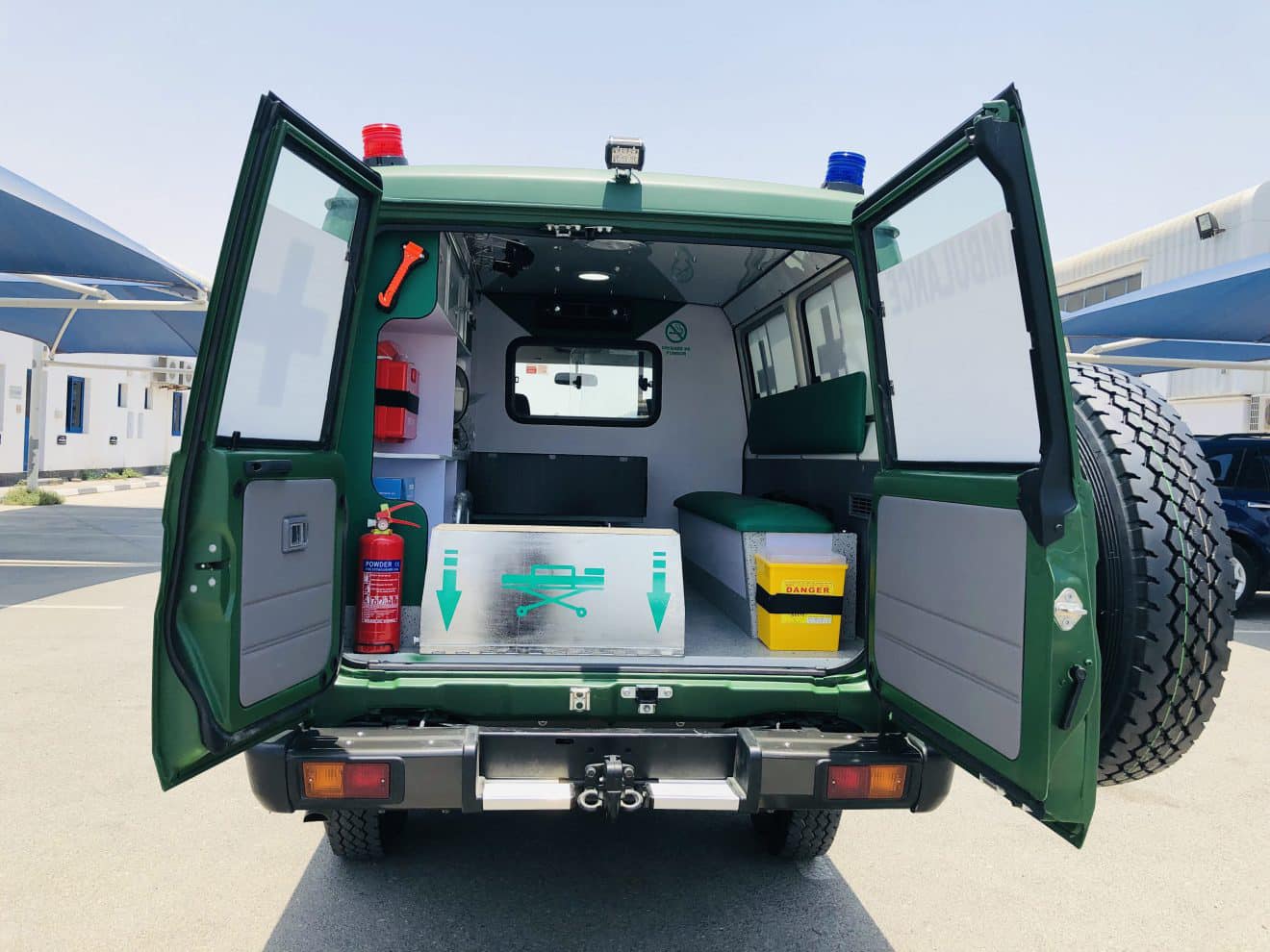
Interior configuration for 2 stretchers and up to 4 seated patients
-
Combat casualty care layout with shock-absorbent stretcher mounts
-
Integrated oxygen, suction, defibrillator, and trauma care equipment
-
Red/white blackout interior lighting for night ops
-
Air conditioning system up to 38,000 BTU with NBC filtration options
-
Rear or side patient access with anti-blast doors
-
Battery management and auxiliary electrical systems for mission support
-
Secure communications systems, intercom, and encrypted radio integration
Compliance & Certification
ICU’s armored ambulance vehicles are designed to meet key military and industrial standards, with the ability to provide:
-
EN 1789-based interior medical layout, adapted for military requirements
-
Ballistic certification based on STANAG or VPAM standards
-
ISO 9001:2015 quality management compliance
-
CE marking for medical systems where applicable
-
Export documentation, end-user certificates, and homologation support
Applications
ICU’s Military Armored Ambulances are fielded in a variety of demanding operational environments:
-
Military field hospitals and forward operating bases (FOBs)
-
Combat casualty evacuation (CASEVAC)
-
Peacekeeping and stabilization missions
-
Border patrol medical support units
-
Disaster relief in hostile or unsecured regions
Customization Options
Every ICU armored ambulance can be tailored to mission-specific needs:
-
BLS, ALS, or Tactical ICU configurations
-
Left-hand or right-hand drive export variants
-
Climate packages for desert, tropical, arctic, or temperate zones
-
NATO-standard or client-specific camouflage coatings
-
Secure communication, GPS, and battlefield telemetry integration
-
Modular equipment mounts for field upgrades
Request a Quotation or Technical Dossier
Contact Infinity Chassis Units to receive a technical datasheet, protection level matrix, and a customized quotation for your armored ambulance vehicle needs. We work closely with defense procurement agencies and international partners to ensure delivery of certified, compliant, and mission-ready vehicles.
Frequently Asked Questions – Military Armored Ambulance
What chassis platforms can be used for the armored ambulance?
ICU’s military ambulance conversions are highly flexible and can be implemented on a wide range of armored platforms, depending on mission requirements and terrain. We frequently work with 4×4 tactical vehicles, MRAPs (Mine-Resistant Ambush Protected vehicles), APCs (Armored Personnel Carriers), and armored Toyota Land Cruiser 70 or 300 Series for light mobility in urban or rugged environments. Each chassis is evaluated based on ballistic protection level, payload capacity, and mobility requirements. For instance, BR6 and BR7 armored vehicles can be used where higher protection against ballistic threats is necessary, especially in peacekeeping or high-risk zones. As a leading armored vehicle manufacturer, ICU ensures full integration between medical systems and tactical performance across all platforms.
What levels of ballistic protection are available?
ICU offers armored ambulances with certified protection levels ranging from STANAG Level 1 to STANAG Level 3, with custom solutions for BR6 or BR7 armored specifications. This ensures the safety of both medical teams and patients during operations in combat zones or unstable regions. Ballistic armor packages are tested for resistance against small arms fire, fragmentation, and roadside IEDs (Improvised Explosive Devices). In our BR7-level configurations, vehicles can withstand 7.62×51 mm armor-piercing rounds, which is critical in active war zones. This level of protection aligns with the increasing demand for armored ambulances in conflict-prone regions. ICU conducts rigorous engineering and certification to meet international protection standards and mission-specific risks.
Is the medical layout compliant with EN 1789?
Yes. While armored ambulances are military in nature, ICU designs the medical interior in alignment with the EN 1789:2020 European Standard for Ambulance Systems, adapted for tactical and combat operations. This includes shock-resistant stretcher mounts, secured oxygen supply, medical storage units, and specialized climate control for patient stabilization. Our armored ambulance interiors support Basic Life Support (BLS), Advanced Life Support (ALS), and even Tactical ICU requirements. This hybrid approach—combining combat survivability with medical compliance—is one reason ICU is increasingly recognized among leading armored ambulance manufacturers in the global defense and humanitarian sectors.
Can these vehicles be used in desert or tropical environments?
Absolutely. ICU armored ambulances are engineered for use in extreme environmental conditions, from the heat of desert operations in the Middle East and Africa to tropical climates in Asia and Latin America. Vehicles are equipped with climate control systems up to 38,000 BTU, reinforced insulation, and optional NBC filtration systems for chemical/biological threats. This makes them suitable for multi-theater deployments. Many clients request custom climate packages for high-heat zones like the Gulf or North Africa, where armored Toyota Land Cruiser ambulances and Hilux-based medical units are commonly used due to their off-road capabilities. ICU also provides environmental stress testing to ensure system reliability under harsh conditions.
Do you support export to defense agencies worldwide?
Yes. ICU is an established export armored ambulance supplier with experience shipping to over 30 countries, including regions in Africa, the Middle East, Southeast Asia, and Latin America. We provide full support for export documentation, end-user certificates (EUCs), compliance with local homologation, and project-based engineering adaptation. We understand that export of armored vehicles and tactical ambulances involves high-level regulatory oversight, and we work closely with governments, NGOs, and defense procurement departments to ensure smooth project execution. As armored vehicle demand grows globally—with high search interest in “armored cash in transit”, “armored land cruiser”, and “armored ambulances”—ICU positions itself as a technically sound and compliant manufacturer.
What is the lead time for production and delivery?
Typical production lead times for ICU armored ambulances range between 10 to 16 weeks, depending on the base vehicle platform, protection level, and interior configuration. For high-spec models like BR7 armored vehicles or those with advanced telemetry and ICU-grade medical systems, production may extend slightly due to system integration and certification. ICU offers transparent project timelines and milestone updates, ensuring that government or NGO clients can align the vehicle delivery with broader operational planning. For urgent deployments, ICU also maintains a limited stock of pre-armored base units for rapid conversion, especially for high-demand models like armored Sprinter vans or Land Cruiser ambulances.
Is there support for spare parts and lifecycle maintenance?
Yes, ICU offers complete after-sales support, including spare parts supply, technical documentation, training, and on-site service support where needed. For defense and emergency service fleets, we also offer Preventive Maintenance Kits (PMKs) and Long-Term Support Agreements (LTSAs) to ensure vehicle readiness. Spare parts for both armored systems and medical equipment can be supplied globally, with priority response for mission-critical clients. ICU’s support network is tailored for clients operating in remote or conflict-affected areas, and we maintain strong logistical channels for fast deployment of parts. With increasing inquiries for bank armored car dimensions, cash-in-transit vehicle maintenance, and tactical ambulance longevity, ICU ensures that its support systems are as robust as the vehicles we build.