Type 1 vs Type 2 vs Type 3 Ambulances; Choosing the right type of ambulance is crucial for operational efficiency, patient care, and budget management. The classification into Types 1, 2, and 3 (primarily used in North America but understood globally) defines the vehicle’s structure, capability, and, consequently, its price. For 2026 procurement, understanding these differences is more important than ever.
Here is a detailed breakdown of each type, its ideal use cases, and how they correlate with the 2026 price points.
Overview: The Core Difference
The classification is based on the vehicle chassis and the integration of the patient module (box).
| Feature | Type 1 Ambulance | Type 2 Ambulance (Van-Based) | Type 3 Ambulance (Cutaway Van) |
|---|---|---|---|
| Chassis | Heavy-duty truck (e.g., Ford F-550, Chevrolet 4500) | Modified van (e.g., Mercedes Sprinter, Ford Transit) | Cutaway van chassis (e.g., Ford E-450, Ram 3500) |
| Construction | Separate, modular patient “box” mounted on truck frame. | Raised roof is added to the original van body. | Separate, modular patient “box” attached to a cutaway van cab. |
| Pass-Through | No direct walk-through between cab and box. | Yes, a direct, open walk-through from cab to patient area. | Yes, a secured, doorway-style pass-through between cab and box. |
| Primary Use | Advanced Life Support (ALS), Mobile ICU, Long-distance | Patient Transport (BLS), Basic Emergency | Advanced Life Support (ALS), Emergency, Specialized |
| 2026 Price Range | $95,000 – $1,150,000+ | $28,500 – $95,000 | $70,000 – $95,000+ |
Type 2 Ambulance: The Van-Based Workhorse Type 1 vs Type 2 vs Type 3 Ambulances
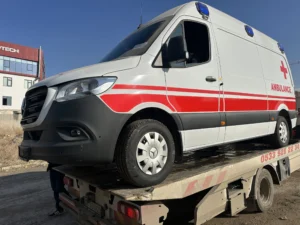
Typical 2026 Models: Toyota Hiace, Ford Transit, Mercedes Sprinter, Volkswagen Crafter, Fiat Ducato.
- Construction & Feel: This type starts as a standard van. The conversion involves reinforcing the frame, adding a high or raised roof, and outfitting the interior. The cab and patient compartment are one continuous unit.
- Ideal Use Cases:
- Non-Emergency Patient Transport (NEPT): Ideal for scheduled hospital discharges, dialysis transfers, and doctor’s appointments.
- Basic Life Support (BLS): Suitable for emergency calls where the patient requires basic monitoring and stabilization.
- Urban & Tight-Area Operations: Their smaller size and better fuel efficiency make them perfect for city environments with narrow streets and parking challenges.
- Cost Analysis (2026):
- Entry-Level (BLS): A Toyota Hiace 2.7 Manual at $28,500 represents the most cost-effective Type 2 for basic transport.
- Standard (BLS/ALS Capable): Models like the Ford Transit ($77,500) or Mercedes Sprinter ($85,000) offer more space and power for comprehensive equipment, bridging the gap to advanced care.
- Why the Cost Spread? Price depends on chassis size (3.5-ton vs. 5-ton), roof height, powertrain (4×4 adds cost), and the level of medical equipment installed.
Type 3 Ambulance: The Hybrid for Advanced Care
Typical 2026 Models: GMC Savana 3500, Ford E-450, similar cutaway vans. In international markets, many Iveco Daily or MAN models built on cutaways fall into this category.
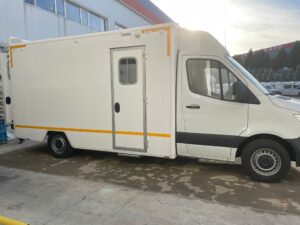
- Construction & Feel: Built on a “cutaway” van chassis (a cab with an exposed frame rear). A separate, modular patient compartment (the “box”) is permanently attached. It features a pass-through doorway connecting the cab to the box.
- Ideal Use Cases:
- Advanced Life Support (ALS) / Emergency Response: The standard for many emergency services. The modular box allows for more customized, robust cabinetry and equipment mounting.
- Higher Capacity & Durability: Offers more interior space and payload capacity than a Type 2, ideal for services that carry a wide array of gear and multiple crew.
- Specialized Units: Often used as a platform for specialized units requiring extra space for specific equipment.
- Cost Analysis (2026):
- The GMC Savana 3500 models ($65,000 – $70,000) are classic Type 3 examples.
- The Iveco Daily ($75,000) and MAN ($95,000) represent the heavier-duty, Euro-style Type 3 ambulances built for high-intensity use.
- Why the Cost? You are paying for a more durable chassis designed for constant stop-start use, plus the engineering of a modular body that offers greater interior customization and often better crash isolation for the patient module.
Type 1 Ambulance: The Heavy-Duty Responder Type 1 vs Type 2 vs Type 3 Ambulances
Typical 2026 Models: Ford F-550, International CV, Freightliner M2.
- Construction & Feel: A heavy-duty pickup or commercial truck chassis with a completely separate, modular ambulance body mounted on the back. There is no physical pass-through; crews access the patient area via exterior doors.
- Ideal Use Cases:
- Rugged & Remote Terrain: Superior for rural, mountainous, or off-road environments due to robust 4×4 capabilities and ground clearance.
- Maximum Space & Payload: Offers the most interior space for critical care teams, multiple patients (in MCI configurations), or large amounts of equipment.
- Special Operations & Mobile ICU: The platform of choice for the most advanced Critical Care Transport (CCT) units and rescue operations.
- Cost Analysis (2026):
- The provided Ford F550 4×4 ambulance at $1,150,000 USD is a prime example of a top-tier, standards-compliant (e.g., KKK-A-1822) Type 1. This price includes extreme durability, advanced safety crash-testing, and the highest-grade medical installations.
- More standard Type 1 configurations start closer to $95,000 – $200,000, but the price escalates quickly with customization, 4×4 systems, and compliance certifications.
Decision Guide: Which Type is Right for Your 2026 Needs? Type 1 vs Type 2 vs Type 3 Ambulances
| Your Primary Need | Recommended Type | 2026 Cost Consideration |
|---|---|---|
| Scheduled Medical Transport | Type 2 | Most economical. Budget $35,000 – $85,000. |
| City-Based Emergency Response | Type 2 (Large) or Type 3 | Balance of agility & capability. Budget $75,000 – $95,000. |
| County/Regional ALS Service | Type 3 | Industry standard for space and durability. Budget **$70,000 – $95,000+. |
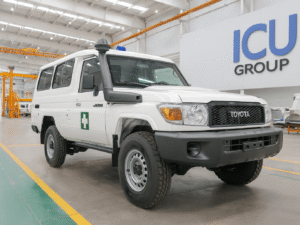
| Rural, Wilderness, or Off-Road Rescue | Type 1 (4×4) or 4×4 SUV (e.g., Land Cruiser) | Essential for capability. Budget $45,000 (SUV) to $200,000+ (Heavy Duty). |
| Critical Care / Mobile ICU | Type 1 or Large Type 3 | Maximum space for equipment & crew. Budget $95,000+. |
Final Advice for 2026: Always match the ambulance type to your mission profile. A rural service buying a Type 2 van for its low cost will face limitations in winter. An urban transport service buying a $1M Type 1 is a significant overspend. Use the chassis prices as your foundation, and remember that the final cost is a direct reflection of capability, durability, and compliance. For 2026, investing in the correct type from the start ensures long-term operational success and cost-effectiveness.